

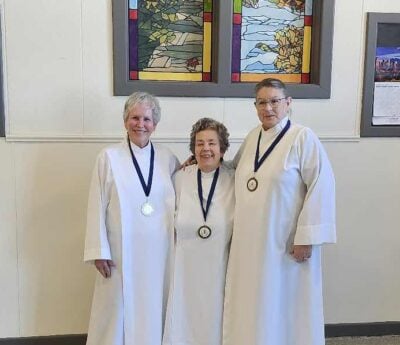
Licensed Lay Readers in the diocese will now be wearing newly minted medallions identifying their roles in parishes — which includes leading worship services and preaching, as well as other responsibilities such as pastoral care, education and administrative work.
The Rev. Bob Albert, warden of lay readers, told Perspective that in the past, medallions were worn by lay readers in the diocese of Ottawa, but in more recent years they have been wearing a blue scarf with their white albs (robes).
Albert had been working with Bishop Shane Parker (prior to his election as Primate of the Anglican Church of Canada) to streamline the information and documents about training and becoming a lay reader, and in the process, they also discussed what lay readers wear. The bishop thought the blue scarves were too similar to the stoles that clergy wear with their robes and it might be confusing. He suggested that medallions would be more distinctive.
Albert started working on the concept and initial designs. The bishop had suggested that the design should incorporate the diocesan colours and ray logo, so Albert consulted with Carole Breton, diocesan director of communications, on ways to incorporate diocesan branding. Breton enlisted the help of Marcela Hurtado, who is the diocesan donor relations officer but also has a background as a graphic designer. She recently created the logo for the new diocesan Hearts of Compassion Fund.
The result of their collaboration is now realized in medallions that Albert is distributing to incumbents to present to the lay readers. The design incorporates symbolic elements associated with lay ministry, including an open book and cross, representing scripture, proclamation, and service. These elements are framed by a laurel wreath, a traditional symbol of honour, dedication, and faithful service, reflecting the commitment entrusted to lay readers.
There are about 60 Licensed Lay Readers in the diocese. Albert explained the process of becoming a lay reader begins when an incumbent identifies a parish need for additional services that are not necessarily clergy-led and sends a request to the bishop for one or more lay readers.
Historically, the next step would require a few years of training, but Albert says that people who are interested in becoming licensed lay readers have often already done quite a lot of educational work such as the Education for Ministry program or taken courses at theological schools, so there is now more flexibility for an incumbent to assess what training the individual still requires.
Albert created training modules and checklists to help incumbents assess a person’s readiness to become a lay reader.
The lay readers have gatherings every six months with a focus on supporting and learning from one another, he said.

Saint John’s interior circa 1890s — Ottawa Centre Deanery