
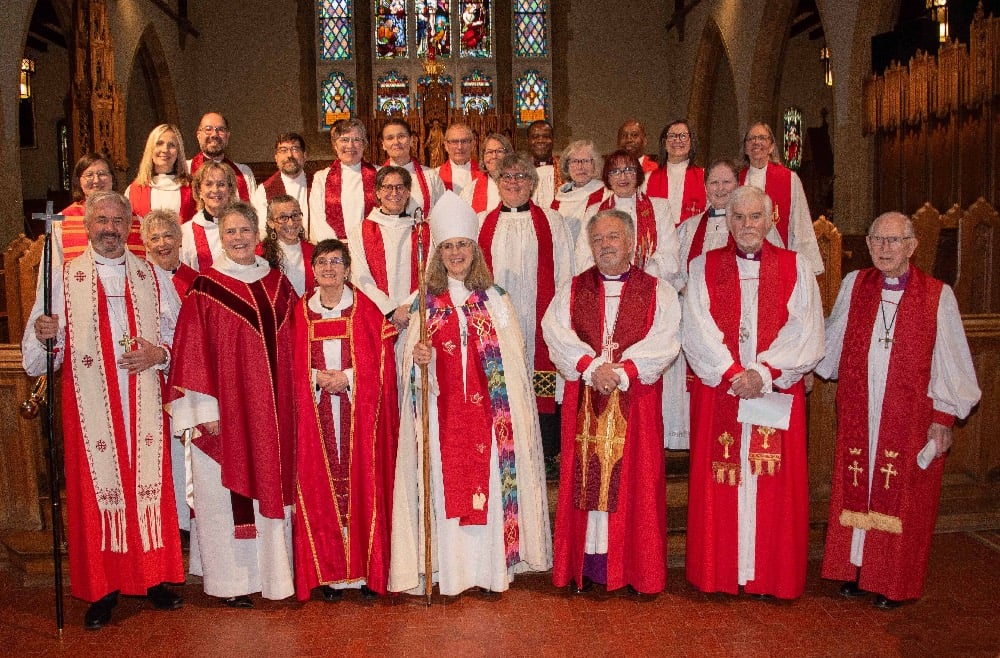
As the Anglican Church of Canada celebrated the 50th anniversary of the ordination of women as priests in November, Christ Church Cathedral Ottawa hosted a diocesan celebration on Nov. 14 with a Choral Eucharist service, reception and launch for a new book by the Rev. Canon Martha Tatarnic.
Celebrating Women in Leadership marked the 50th anniversary of the ordination of women as priests, the 25th anniversary of the creation of the Cathedral’s Girls Choir and the 130th anniversary of the Diocese.
Bishop Kathryn Otley offered a sermon reflecting on women’s changing roles in the Church. The Gospel reading from John (20:11-18) recounted the moving story of Mary Magdalene meeting Jesus in the garden outside the tomb, recognizing him only when he calls her by name, and being the first to announce to the disciples, “I have seen the Lord.”
The bishop had also selected a reading from the Book of Romans (16: 1 – 16) in which the apostle Paul sends greetings to dozens of friends and co-workers in the early Church serving in many different ways: “Deacon, apostle, patron, coworker, host, tireless labourer, none of these roles were restricted to men. They belong to women and men alike.” The community, she noted, was “made up of single people, married couples, widows, widows, people of every age and stage of life. It is a natural balance of God’s people, serving the Lord.”
Over the centuries, that natural balance was lost. She outlined how “women lost the right to own property and were increasingly confined to the private sphere and men to the public. “This exclusion became so entrenched in the church that later scribes and translators actually altered the text of this letter [to the Romans], turning the female apostle, Junia, into a man named Junius, a deliberate alteration known today in scholarly circles as ‘sex change by translation.’”
But the movement to restore balance in the Church began long before 1976. “All over the world, women were stepping into leadership roles in their communities and in the Church, both as lay leaders and in religious orders. Today, we celebrate those foremothers” the bishop said, mentioning as examples:
- The Sisters of St. John the Divine, founded in 1884 in Canada running extensive hospital ministries and schools
- Women’s Auxiliaries sent women out as missionaries, social workers and teachers in Canada and beyond
- Eva Hasell’s Sunday School Caravan Mission brought women educators to isolated farms across Western Canada
- The Bishop’s Messengers founded in the Diocese of Brandon in 1928 were a group of lay women who went where male clergy would not go and did the full work of clergy without recognition or benefits
Eventually, the Anglican Church of Canada allowed women to become deaconesses, but that was a lay order. They were not ordained.
Then Bishop Otley recounted how change was realized officially in the Anglican Church of Canada: In 1976, on Nov. 30, six women were ordained to the diaconate in the dioceses of New Westminster, Caribou, Niagara and Huron. They were ordained with their male colleagues using the exact same service.
Four years later, in April of 1980, Sarah Boyles and Sally Eaton were ordained to the diaconate in the Anglican Diocese of Ottawa, and in December, they were ordained to the priesthood. They were soon followed by Dana Johnston, Gwenda Wells, Susan Churchill-Lackey, and Pat Johnston.
“Let us rejoice and look at what grew from those faithful beginnings,” she said. “Today, in our diocese, 25 women serve actively alongside 31 men. They serve as deacons, priests, regional deans, archdeacons, cannons, a dean, an executive archdeacon, and as your bishop. Beyond the ordained ministry, women lead across every corner of our diocese — directing music, choristers, serving as liturgical leaders and lay readers, guiding parish, community, and education ministries, and serving in communications, administration, and executive leadership. Restoring what I’m calling this natural balance required men and women working side by side.”
This change did not come without opposition. She noted that in 1975, just ahead of the first ordinations, a manifesto from concerned clergy declared that a woman by her very being could not be ordained. But returning the first reading from Isaiah, she said that God’s life-giving breath and spirit are poured out without distinction. “They are not reserved for one gender but are the shared inheritance of every child of God. And so, we persevered. Women and men together, step by step, moving from limited participation to full inclusion, deepening our discernment of vocation and the movement of the Holy Spirit. Today, our diocese continues to grow in wisdom, enriched by diverse cultures, genders, orientations, as we all strive to live fully into our baptismal covenant.”
Appropriately, the Cathedral’s Girls Choir, celebrating their 25th anniversary, sang for the service joined by alumni and the choir’s original director Timothy Piper, as well as current director James Calkin.
Archbishop Shane Parker, Primate of the Anglican Church of Canada, took part in the Eucharist service and shared the story of the choir’s creation in a letter in the Order of Service bulletin. He noted that Frances Macdonnell became the Cathedral organist and director of music in 1980, the same year the first women were ordained in the diocese.
The idea of a Girls Choir was discussed and studied for years, but finally in late 2000, Parker, who was then Dean of the Cathedral, asked Piper, a former chorister and multi-talented musician if he would start the choir if funding could be arranged. He accepted and then the dean asked the gentlemen of the Cathedral’s Trust Fund to secure start-up funds. With enthusiastic support from many members of the Cathedral parish, the Girls Choir became a reality in 2001. The choir’s distinctive sound became “a robust and dynamic part of the life and ministry” of the Cathedral, “going from strength to strength when James Calkin became its second director,” the Primate recalled. “It was a great joy to play a part in establishing the Girls Choir and to see how it has touched so many lives over the past 25 years,” he wrote.
A festive reception followed the service the Great Hall and then afterwards, Dean Beth Bretzlaff interviewed the Rev. Canon Martha Tatarnic about her latest book, Anne Boleyn: Reputation, Revolution Religion and the Queen Who Changed History, which illuminates the Queen’s little-known role in creating the Church of England.



All Saints, Nepean, elevation by T. Fuller — Ottawa West Deanery