
Conversations with diocesan archivist Glenn Lockwood often yield a wealth of information and intriguing history that the inquirer would have never known to ask about.
And so it happened this spring when All My Relations (AMR) Episcopal Panel co-chair Kathryn Fournier visited the Archives to entrust a number of AMR books and resources, such as a copy of the Indigenous Peoples’ Atlas of Canada, to the Archives so they would be available and accessible to people in the diocese.
On the subject of such resources, Lockwood mentioned that all the churches that operated Indian Residential Schools on behalf of the Canadian government agreed to send all of their documents related to the schools to the National Centre for Truth and Reconciliation in Winnipeg as a part of the Indian Residential Schools settlement. Here in the Anglican Diocese of Ottawa, that required copying and sending about 14,000 documents. It was a three-year project (2013 – 2015) for volunteers Mary Barker, Lynn Glenn and Caroline Herbert who searched the collections for references to the schools. Then archivist Meg Stewart compiled an index of those 14,000 documents copied and shipped to Winnipeg.
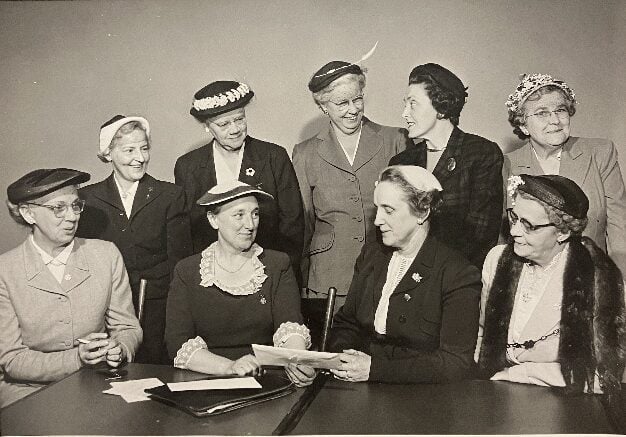
Fournier said she was flabbergasted that there were so many since there were no residential schools located in the diocese, so people here may have felt “one-step removed” from that history. Information from Lockwood and her initial perusal of the documents, however, revealed that Woman’s Auxillary groups from many parishes were very involved in sending bales of goods to the schools right across Canada from the early 1900s, often to particular students who they knew by name. It’s all there in hand-written minutes of their meetings., Fournier said. “Shipping them all over Canada and up to the Arctic over so many years. That to me, indicate a, a fairly high degree of engagement.”
The women certainly did this charitable work with the aim to support the children and their education and likely viewed the schools’ aim to provide Indigenous children with education in a positive light, without knowing about the suffering and abuse many endured while they were students. And yet, present-day Anglicans could read a report of bales sent to students in the years between the early 1900s and the 1920s knowing that it was during that time that Dr. Peter Bryce wrote and published reports on terrible conditions in the schools that he warned were contributing to the deaths of children. Dr. Bryce’s reports were disregarded by the federal government of the time, which suspended funding for his research, blocked presentations of his findings and eventually forced him out of public service and into retirement.
Fournier thought that Anglicans in the diocese would be interested to explore the files and learn how people in their parishes or families, perhaps a great-grandmother, were engaged in trying to support the children in the schools.
Editor’s note: Details about Dr. Peter Bryce’s reports have been added to this version of our original story to be published in the October print edition of Perspective.
Saint John’s interior circa 1890s — Ottawa Centre Deanery