
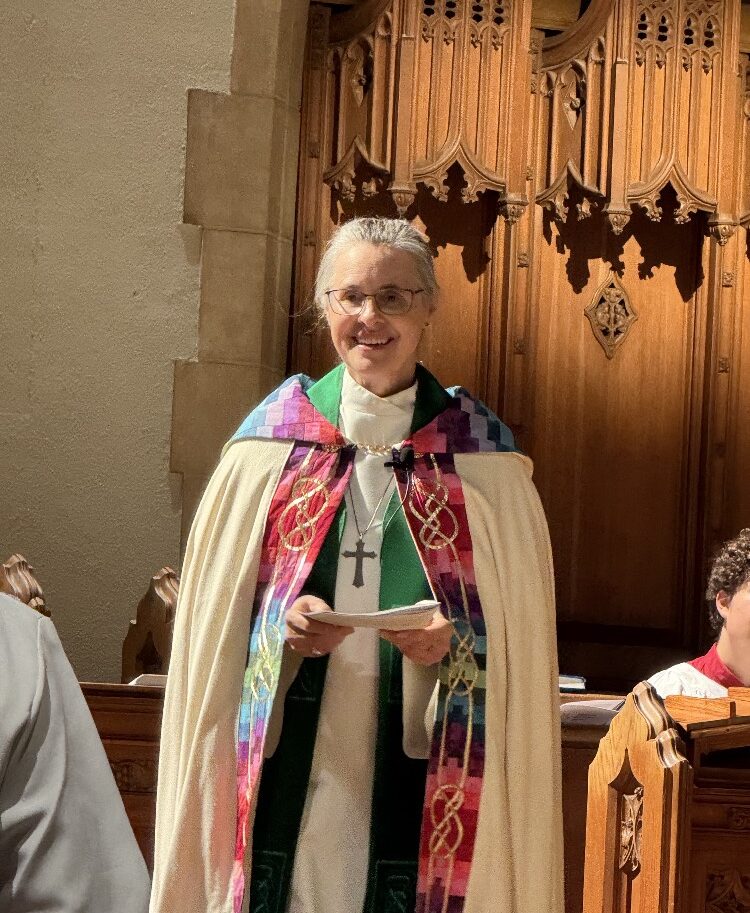
Bishop Kathryn Otley’s message to parish and ministry leaders, delivered at Christ Church Cathedral Ottawa on Oct. 22, 2026
It is my privilege to introduce our theme for the 147th synod of our diocese:
Listening and Building Relationships in Hope
Isaiah speaks God’s promise to a people gathered from east and west, north, and south: “Do not fear, for I have redeemed you; I have called you by name, you are mine.” We come to this Synod from every deanery—East Ottawa and East Ontario, West Ottawa and the Southwest, Northwest Ottawa and Western Quebec, and the Central and Cathedral deaneries—held together not simply by geography or institution, but by the God who calls us by name.
Luke’s Gospel shows us how the risen Christ accompanies people on the road. Jesus comes near, asks a question, and listens before he speaks. He receives the disciples’ grief and disappointed hope, opens the Scriptures, and is made known in the breaking of the bread. Their encounter becomes relationship; their relationship renews hope; and their hope sends them out to share the good news.
This is the pattern I invite us to follow in the year ahead. As Saint Paul reminds us, the Scriptures give instruction so that by steadfastness and encouragement we can sustain a common life rooted in hope through the power of the Holy Spirit.
Listening before we decide
Over the past six months, and during the town halls prior to the episcopal election, I heard clergy and laity describe the gifts, hopes, pressures, and possibilities across our diocese. These conversations have reminded me that faithful leadership begins not with ready-made answers, but with attention: to God, to one another, and to the communities we serve.
Under our regular cycle, this Synod would consider a three-year budget for the next triennium. However, after a year of notable change, including the episcopal transition, such a decision would be premature. Instead, we will consider a one-year budget and use the coming year to listen broadly, assess our circumstances, discern priorities, and prepare strategic directions for the next Synod.
This year of listening is not a pause in ministry. Parish visits and conversations with lay leaders, clergy, diocesan staff, and community partners have already brought urgent concerns and promising opportunities into focus. These will shape our work at in the months ahead.
Relationships that shape our priorities
Our priorities are not separate projects. Each grows from relationships. Listening well will help us deepen relationships and respond faithfully, especially in the following areas:
Youth ministry
Learn what is working regionally and where gaps remain. Develop guidelines to include the presence of youth delegates at synod before the 2027 vestries. Connect our efforts with the Provincial Youth Council and the emerging National Youth Council.
Indigenous relations, reconciliation, and Inuit ministry
Work with the All My Relations panel to increase Indigenous participation on the panel. Begin a relationship with the Algonquin people on whose homeland we live, meet, worship, and serve.
Listen to the Inuit community at St. Margaret’s and other Inuit groups across the city. Renew our relationship with the Diocese of the Arctic, learning from and participating in its lay-leader training programs offered in Inuktitut.
Buildings and property
Address the growing cost of maintenance and improvements by proposing a new fund to ease long-term planning and financial pressure.
Wellness and sustainability
Address exhaustion among clergy, lay leaders, volunteers, and congregations by discerning what is essential, what can be renewed, and what can be released. Reimagine parish organisation to reflect present capacity, encourage growth, and welcome new volunteers.
Vocations and formation
Adapt discernment, training, and internships to the realities of candidates who may be married, carrying mortgages, or entering ministry as a second career, while maintaining the requirements for ordination.
Liturgy
Review existing guidelines and emerging trial resources, recognizing that our prayer both forms us and reflects who we are.
Discernment in Community
No single parish or diocesan body holds all the wisdom we need. As we pursue priorities identified at past Synods, we will expand the Learning Commons, facilitating parishes’ ability to contribute new resources so that their experiences can be made widely available.
Great Chapters will become places of sustained regional listening, attentive to what the Spirit is saying in each context. Challenges such as property, stewardship, and parish leadership are widely shared, but our responses must reflect the distinct realities of inner-city and suburban communities, villages and towns, rural centres, and isolated churches.
In each region, we will listen together around four questions:
What is working well?
Where are the gaps?
What is no longer working and should be changed or released?
What new possibilities could we explore?
Contributions from these regional conversations will be brought to Diocesan Council and will inform the strategic directions presented to next year’s Synod.
Hope already taking root
We begin this work with gratitude for the ministry already flourishing among us. Our clergy, lay leaders, diocesan staff, and community-ministry volunteers strengthen congregations and support neighbours in need. We celebrate the many ministries, new worshipping communities, contextual mission inspirations, faith formation and educational opportunities and so much more that our diocese offers. We also rejoice in our partnerships with Partnerships with the Anglican Foundation and Alongside Hope which extend our service throughout Canada and around the world.
Housing insecurity, homelessness, and barriers to care continue to affect the most vulnerable people in our communities. We honour the Ellwood House extension, our connection with Multi Faith Housing and its new building, Odenak, and the compassionate, practical response of our Community Ministries. As needs become more complex, we will strengthen partnerships with civil government at various levels and with ecumenical, interfaith, and secular organisations. Our parishes are essential to this mission. Their relationships with all community ministries create a tapestry of care -—we weave distinct colours and fibres creating a strong and beautiful tapestry of diocesan outreach. In this way, together, in the power of the Holy Spirit, we share the good news of God’s love in Jesus Christ.
The stories of contextual parish mission we will hear at Synod are not formulas to copy. They invite us to recognise the gifts and needs of our own communities and imagine what faithful ministry might become in each place.
Learning through partnership
Our partnership with Saint Paul University shows how a relationship can evolve over time. The Anglican Studies Program, established in 1981 with the Faculty of Theology, offered learning for laypeople, formation for those preparing for ordination, and broader education about the Anglican Church. A renewed agreement in 2020 expanded courses and programs for learners locally and nationally.
This year, the Anglican Studies Program will become the Centre for Anglican Studies, providing a stronger foundation for future growth. Canon Dr. Sarah Kathleen Johnson will speak about the opportunities this development offers for education, formation, vocation, and service.
Beyond this educational partnership, we will nurture our close tie with the Diocese of Jerusalem and deepen relationship with our ecumenical and interfaith connections. We do this knowing that joining our voice with others advocating for social and ecological justice has a greater impact than our voice alone.
Faithful change
As these relationships develop, we will find that familiar structures or practices need to change. This does not mean they have failed. Political, demographic, financial, and pastoral circumstances evolve; faithfulness requires us to respond thoughtfully rather than wait until change overtakes us. We can honour what served the Church in another season while asking with our present understanding, what is healthy, just, and life-giving now. This evolution is taking place at all levels of our church as nationally and provincially we respond to the Pathways passed at the General Synod in 2025.
I find the image of the church shared by Pope John the 23rd helpful: the Church is more like a garden than a museum. A garden carries the story of what has been planted and tended, yet it remains alive. Gardeners pay attention, adapt to changing conditions, welcome new growth, and prune so that life may flourish. In the same way, careful listening can help us distinguish what should be cherished, what needs to be renewed, and what we are being called to release.
Abounding in hope
On the road to Emmaus, the disciples began with the words, “we had hoped.” Jesus does not dismiss their disappointment. He walks with them, listens to their story, helps them see anew, and breaks bread together with them. Relationship is reborn, their hearts are rekindled and hope becomes action.
That is our calling in this season. Our hope rests in God’s faithful presence. Isaiah assures us that the God who created us, gathers us, knows us and redeems us, remains with us through deep water and fire. Paul calls us to receive one another as Christ has received us, so that with one voice we may glorify God and abound in hope by the power of the Holy Spirit. Luke shows us the risen Christ meeting people on the road and forming a community around scripture, hospitality, and bread.
May this be the shape of our life together: listening before speaking, walking alongside one another, receiving one another in Christ, and building relationships in which hope can take root. Then, with hearts renewed, may we rise and go—ready to share the good news in word, service, and love.
“We begin this work with gratitude for the ministry already flourishing among us.” — Bishop Kathryn Otley
Foundation supports the Anglican Community Ministries’ frontline compassion