
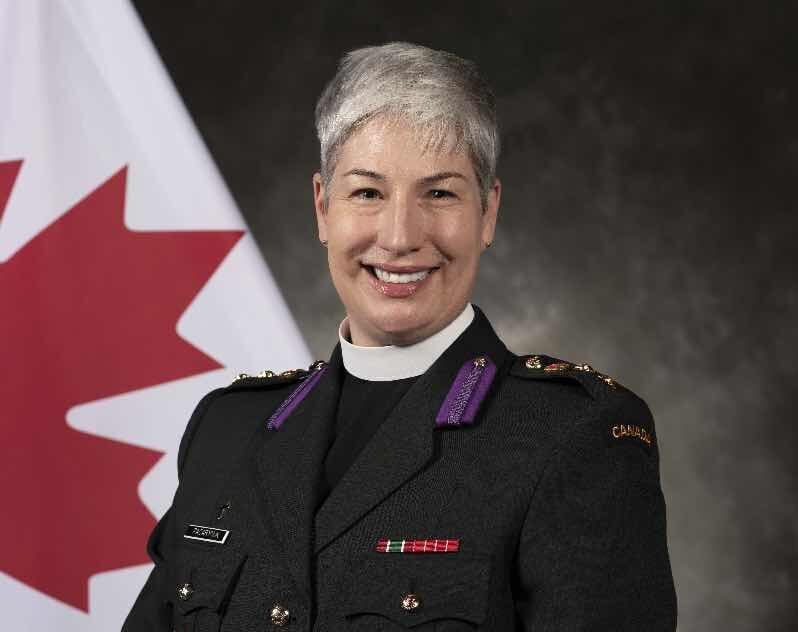
In May 2025, Col. the Rev. Canon Lisa Pacarynuk was appointed as the Chaplain General for the Canadian Armed Forces (CAF). She is the first woman to lead the chaplaincy — which currently includes about 400 chaplains, 250 in full-time or regular force service and about 150 in reserve or part-time service deployed across Canada and abroad. She kindly made time to with Perspective about the chaplaincy and her new role:
How diverse are the faiths represented in the chaplaincy?
In fact, we have people of no faith in our chaplaincy … humanist chaplains, Christians of all stripes, Jewish, Muslim, Buddhist, traditional Indigenous spirituality, and we are working on a training program for a Sikh chaplain and additional humanist chaplains.
How closely do they work together?
We have diverse teams and our motto is ‘Called to serve.’ The idea is that whatever the need is of the person in front of us, it could be expressed to any chaplain and that chaplain would be responsible for facilitating what that person requires. If they were asking for a particular religious service that was not the chaplains’ that they were speaking to, then either they ask a colleague on their team or they have relationships with those in the community to make sure that that spiritual need is provided for.
What are some of the challenges and rewards of working together in this way?
We’re really a model in the worldwide chaplaincies….This idea of chaplains of varying faiths and belief systems working so closely together is quite anomalous for other chaplaincies who are quite focused on the care of their own religious tradition. It’s really enriched all of us in ways that we couldn’t imagine. Starting just even from ecumenical relationships with other Christians. Our Protestant chapels … are an ecumenical group of all the Protestants, whether they be Pentecostal or Baptist or Anglican. It’s a joy and a challenge to work with people of diverse perspectives — finding common ground, finding a place of respect, being open to others’ joys and spirituality and how they express that…St. George’s Chapel in Petawawa is a really active chapel and a really great example of this ecumenical model.
…All of our chaplains are really guided, directed to stay firmly rooted in the tradition that they come from and represent. … So even as you are working closely with other people, you’re not there to lose yourself. You are there to continue to represent who you truly are in that group of people.
When did you feel called to ministry and to the military?
I grew up in Calgary…and in university I discerned a call to certainly greater theological studies. I wasn’t quite sure where it was going to take me, because I grew up Roman Catholic… but I wanted to study theology in a more in-depth way, and so I went straight over to Toronto School of Theology, University of St. Michael’s College after I finished my undergrad. I did a Master of Divinity where, again, as a Roman Catholic layperson, I wasn’t sure what the ministry opportunities were. I did placement work in prison and hospital settings. I felt that institutional chaplaincy was something that I would be drawn to and would be very interested in, as opposed to just regular church work.
And then I saw a poster for Cadet Camp Chaplaincy [as it was called then], which is our cadet and junior rangers program….They were asking for theological students to go and spend summers on these training centres and … offer spiritual care…. I did that for two summers… the second of which was on a working military base where I talked to military chaplains… I really felt that this was a place where I felt called…. I was bilingual. I was adventurous, younger, and felt that having this take-the-church-to-the-people model, bringing the spiritual care to the people, which is kind of what chaplaincy is… was something that I felt really drawn to.
I was hired as a Roman Catholic lay pastoral associate. It’s almost a diaconal role. Pastoral associates had a kind of mandate from the bishop to provide care, help out at churches, bring communion, and do baptisms and weddings where they were required, but in doing that, I felt drawn to greater leadership and felt and saw myself in an ordained ministry position.
I had always dropped in and out of Anglican churches to experience the spirituality and the openness of the Anglican church. In 2008, I discerned that … I had to make the step towards being ordained in the Anglican Church of Canada and found great support from the Anglican Military Ordinariate of the time and Bishop Peter Coffin. Bishop John Chapman was the one who facilitated my training and my eventual reception into the ordination into the Anglican Church of Canada.
What does being the first woman to be appointed Chaplain General mean to you?
It’s always hard to answer because I spent 25 years in the chaplaincy…. You are conscious, as a woman, that you are in the minority. But there was always this growing number of women and a growing recognition that that’s part of our diversity that we really need to continue to foster. Our CAF is made up of men and women and diverse gender identities. Everybody needs somebody to be able to talk to. So, to be the first woman, in a way, you almost feel like it’s a bit late in coming…. But I’m really humbled. I’m really honoured just to be named Chaplain General…. Our motto is Called to Serve and I feel very much called to serve those who serve, and to do that in a way that represents a gender minority in our CAF as an example to all women, especially women of faith. We’ve often been in the minority in our faith communities as well, not recognized as spiritual leaders. So for me, it is a special recognition that women can be spiritual leaders and military leaders. And people have told me that it’s important for them to have that example, and so I honor that.
What proportion of chaplains are women?
About 10 to 15 % of our chaplaincy are women. We would love to have more. I would love to have more because to me that is still clearly not representative of Canadian society, and it is not representative of all of the richness of our faith traditions and their leadership either. And so that is continually [a goal], as we work on recruiting, maintaining a representative face of Canada. It’s really important to me, whether that be spiritual and faith tradition diversity, and certainly gender diversity as well.
Aside from deployments abroad, the CAF often helps with wildfire and floods here at home. Those situations must also be challenging for chaplains.
We’re spiritual first responders when we walk alongside a lot of these other first responders who are going into those disasters when the sensible people are leaving. And it’s a very particular calling to stand alongside people who are doing this difficult work for Canada at home and abroad.
What else would you like readers to know about the work of CAF chaplains?
The chaplains are there in the small times of life, and post COVID, I think we’ve realized that people look for and need connection. …The world is unstable, and so people are looking for grounding and meaning and purpose. I’m really proud that the chaplaincy serves in the Canadian Armed Forces to be that source of hope and inspiration and meaning for people. And as we’re sharing this with [a readership in] the Anglican Church, it’s a place where I think many of our clergy would flourish [serving] either on a part -time or a full -time basis. It’s a very meaningful ministry.
It’s challenging… This is the church that has been sent into this difficult setting… in different parts of Canada and around the world. So, I invite the prayers of our readers because I think our chaplains need prayer and spiritual support and really welcome that. When our chaplains show up in Anglican churches, they’re probably looking for a little bit of nourishment themselves. And so, [I] invite everyone to welcome them and hear their stories, because it’s a very powerful witness to spirit of goodness and hope in the world.
Saint John’s interior circa 1890s — Ottawa Centre Deanery