
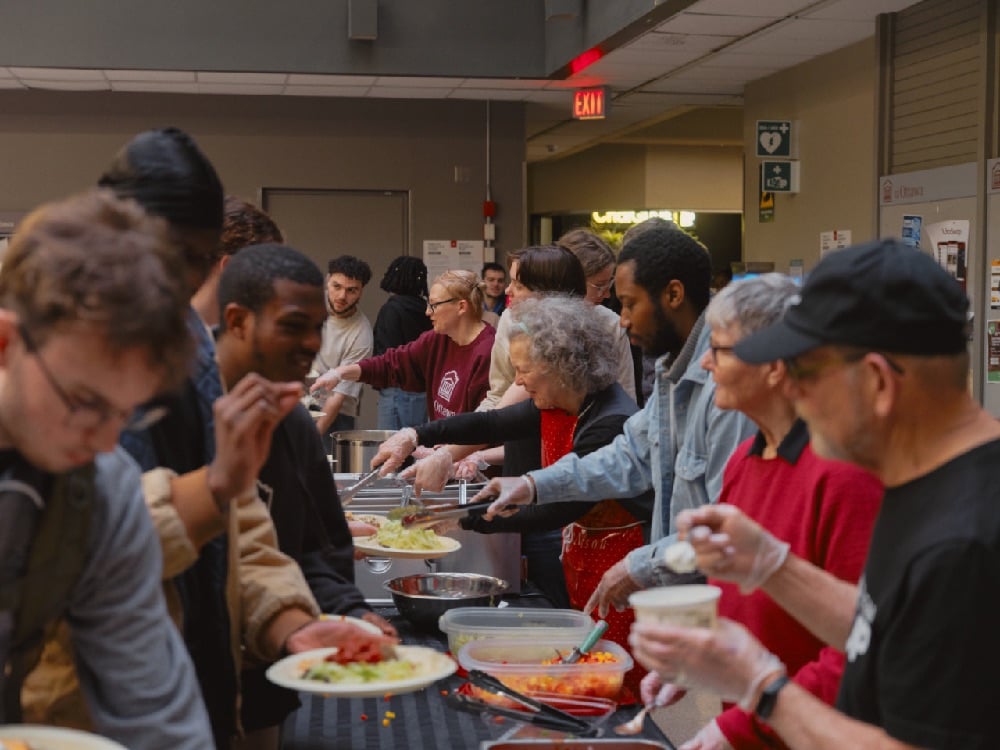
As a chaplain at the University of Ottawa, the Rev. Michael Garner saw that many students were struggling financially and facing food insecurity.
He and parishioners at St. Albans, where he is the incumbent priest, were inspired to create some pilot projects on campus serving meals to students over the last few years. They began by serving meals at one of the student residences where students who didn’t have meal plans lived.
Throughout this past academic year, St. Albans teamed up with the student union, which has its own food insecurity initiative “Fed up.” They moved their program to a central hub area on the main campus and served three lunches and a dinner each semester. The meals were cooked by St. Albans’ parishioners with student volunteers on campus, and to encourage students to cook nutritious and low-cost meals for themselves, the team handed out recipes for the dishes they were serving.

Not surprisingly, the free meals have been a big hit with the students. Garner reports that they served a burrito dinner for their last meal of the semester in mid-April to 385 students. The students are grateful, and Garner says the volunteers often hear that the meal is the only one some students will eat that day.
Students have enjoyed the opportunities for social connections the meals create. Encouraged to sit down and eat and talk together, students offered feedback that the project has had a positive effect on their health. Aside from the food, they benefited from the social connections and a greater sense of belonging.
St. Albans volunteers also made efforts to take a break and sit down to eat and talk with students. Garner was pleased to hear that the students appreciated the opportunities to connect with the adults from the parish. Although, he expected that it would be most appealing to have student peers serving the food, feedback from the student union included comments that the students valued opportunities to have conversations with the adult volunteers from the parish. They appreciated having an adult ask how they were doing, how their day or semester was going, and the sense that these adults cared about them.
The St. Albans group has sought and welcomed partners from other parishes, denominations and faith groups to bolster their efforts in whatever capacity they can contribute. Even if a group can’t take on providing a whole meal, contributing to part of a meal is a valuable way to get involved and support the project. For example, Garner said, a number of United Churches got together and offered to donate dessert for the final meal of the term in April. Initially, they estimated they could provide about 150 servings. However, their bakers participated enthusiastically, and they ended up bringing more than 500 servings. “It was this overwhelming amount of food. That just created such joy…. It was great,” he recalled.
“My hope is next year to continue to cultivate relationships with churches and other groups who can provide supplemental things, like baking biscuits when we were doing soup and that sort of thing. I’m looking for all sorts of ways to lower the barrier to entry to churches and other groups,” he said, suggesting that sometimes people feel overwhelmed by a big problem like student food insecurity and feel that they can’t do anything. “I think the real power of this is that there are smaller ways to …come and be involved.”
Garner acknowledges that the meals can’t solve the problem of food insecurity on campus, but he was pleased to see that highlighting the problem and advocacy work seems to be spurring some action on the issue. The president of the university created an initiative to write an action plan for food security for the whole campus. Garner served on the committee with one of the deans in medicine and St. Albans was included as an external partner.
Pilot project aims to counter students’ social isolation
The Rev. Michael Garner has seen that students at the University of Ottawa, like many people in the broader society, have more communication tools at their fingertips than humans have ever had, but many are socially isolated. He says that loneliness is sometimes described as an epidemic in our digitally connected society where people need more time and real connection with other people in person.
Garner has worked closely with the U of O Student Union on issues of food insecurity, and one day ran into Meredith Kerr, the executive director, in Costco. “What are we going to do about loneliness on campus?” she asked him.
He says his first thought was “I have no idea.” But it was immediately followed by, “I know exactly what we are going to do.” Peg Herbert, a parishioner at St. Albans had come to mind.
“She’s a remarkable woman,” he said. Among the many cool things she has done is starting an organization called Chosen Grandma, which pairs retired women who don’t have grandchildren, or don’t have grandchildren in the city, with single moms, single parent families, creating this connectedness. The idea has caught on and Chosen Grandma has been featured on the CBC news. Garner noted that Herbert is developing this charity even though there are additional legal challenges because there are minors involved, but the point is to give children a “chosen grandma.” He realized that Herbert had all that valuable experience creating connections in a safe way.
So, while standing there in Costco, he thought, “‘We’ll just take Peg’s idea and apply it on campus.’ And that’s what we’re doing,” he told Perspective.
Room Enough is a pilot project will match 10 students with 10 families or households in the next academic year. “It’s really about facilitating the need of students, the desire of these households to connect … and support each other and learn from each other,’ he said. The pilot for this academic year will be a test run to see how this works, see what doesn’t work. They will track participants’ feedback on their mental health, the connection between the students and their matched households. “If we have a positive outcome and we have some data, we’ll go to the university to look at scaling it up for more people to participate in the next year.
The diocesan Future Fund awarded the project a grant of $10,000, which Garner says will help hire a student to be a part-time co-ordinator for the program.

Saint John’s interior circa 1890s — Ottawa Centre Deanery