
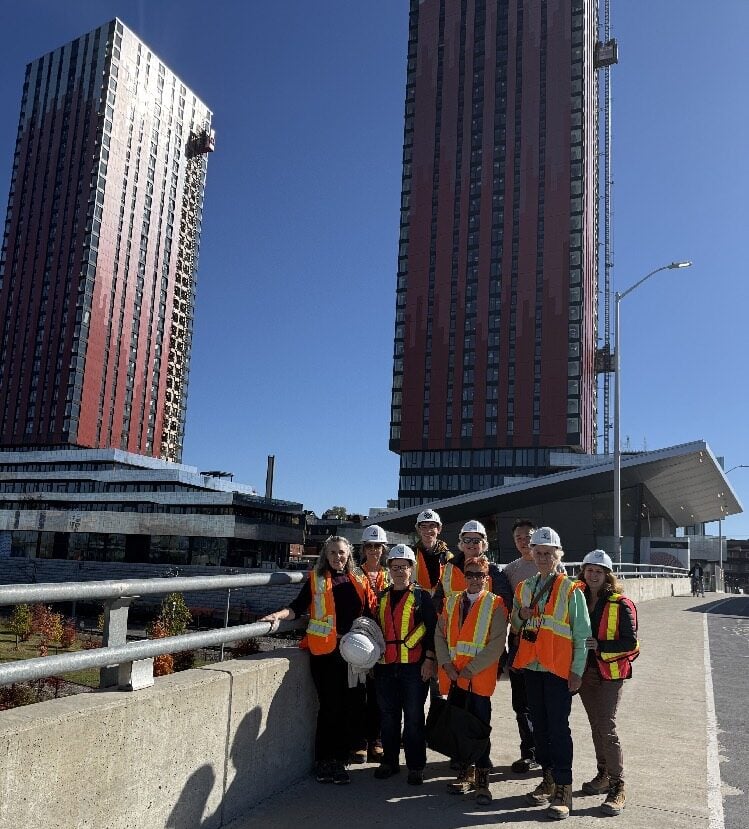
It was a beautiful October day when Bishop Kathryn Otley and representatives of five parishes donned protective equipment to ride a construction elevator to the thirty-first floor of the building that will house Odenak, the Multifaith Housing Initiative’s mixed-use residential development.
They were getting a preview tour of the building on LeBreton Flats that will house 30 units reserved for Indigenous tenants. The Anglican Diocese of Ottawa’s donation in 2024 of $75,000 helped to make that possible with savings of $300 a month for Indigenous families on each rented unit. The donation represents a continuation of Anglican core support that goes back to the founding of MHI.
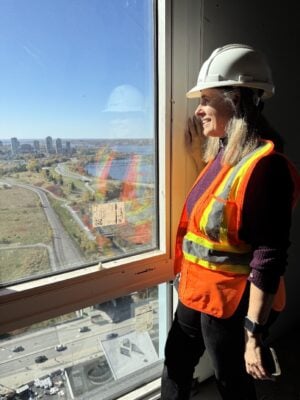
Appropriately, the view from the thirty-first floor looked out on the Ottawa River, the traditional homeland of the Anishnàbeg people. Odenak is the Algonquin Anishinaabe word for community, a characteristic that caught the attention of all in the tour group. “It is a great model,” the bishop said. “It’s so important to connect community with the people who are here.”
She mentioned the success that Christ Church Bells Corners has had, under the leadership of the Ven. Monique Stone, building connections and relationships with the community around its affordable housing project, Hollyer House. Hundreds of people attend community meals and celebrations that the parish hosts with community partners.
Others on the tour were similarly impressed. Marilyn Collins of St John the Evangelist Ottawa, Diocesan Liaison with MHI, said each participant learned new things and appreciated the building’s “amazing” facilities. “It made me want to live there.”
For Alexander Passmore, also of St. John the Evangelist, “It was great to see the amount of care and attention to designing a building that will encourage community,”
Barbara Schultz of St. Barnabas said, “the large light-filled day care space will be wonderful, as will the generous communal gathering spaces,” although she was concerned about the “miniscule” kitchen space with limited capacity to prepare good meals.
Barbara Bottriell of St. Thomas Stittsville particularly liked the common spaces and an outside terrace that will allow all to have those great views of the river and the city.
Marci Taylor of All Saints Westboro said partnering with MHI on Odenak is exactly what the diocese should be doing. “Not only does it put our faith values into action by serving our community, but it demonstrates to all parishes in our diocese, as well as to other faith groups and to the broader community, how our responsibility to our fellow citizens can be enacted.”
Sheldon Leong, director of fund development for MHI, summed up: ”A lot of people are looking at this partnership with NCC, with Dream, with MHI, with the Algonquin community to see how we all work together to create an inclusive community where there is no us, there is no them, it’s just one big community.”
The Odenak project is a partnership between MHI and Toronto-based Dream group members Dream Asset Management Corporation and Dream Impact Master LP.
Dream Group was chosen by the National Capital Commission to develop the “Library Parcel” on Lebreton Flats. The project is due for completion early next year.
This project will build over 608 residential rental units – 250 of them affordable – in two towers at 665 Albert Street, between Ottawa’s future Ādisōke main public library and the Pimisi LRT station.
Of the total MHI’s Odenak will include 133 units that will be rented at about 59 per cent of market rates, including the 30 units reserved for indigenous people. They will benefit from an additional level of affordability, estimated at about $300 a month.
In addition to MHI’s 133 units Dream is also making about 100 of the 608 in the total project more affordable, but at about 79 per cent of market value.
The diocese’s $75,000 donation came from the sale of Christ Church Maniwaki. The idea arose from a conversation between Bishop Shane and Albert Dumont – at the time Algonquin Spiritual Teacher in Residence at Christ Church Cathedral — who had said urban indigenous youth could not afford to live anywhere in Ottawa. It was subsequently determined that the donation was the most appropriate use for the funds realized.
There is a strong focus on sustainable living. Located near the Pimisi LRT station, residents will also be able to walk to a nearby grocery store, the downtown core, Little Italy and Chinatown neighbourhoods as well as the new library next door.
According to information from MHI, Odenak is designed to be “Canada’s largest residential zero-carbon development, employing wastewater energy and solar power-generating systems. The design concept also incorporates LEED Gold Standards for maximum energy efficiency and sustainability.”
Active supporters
The diocese and parishes have been actively supporting MHI from its beginning in 2001. The Rev. Canon Garth Bulmer and Gay Richardson, both of St John the Evangelist at the time, served as president and secretary respectively. They worked tirelessly towards MHI’s first purchase, the five-unit Kent House next to St Barnabas church. Richardson remained active in MHI and on the Bishop’s Panel on Housing Justice until her death last year.
The Rt. Rev. Peter Coffin, bishop at the time, later wrote in Crosstalk that MHI is “an exemplary model of how faith communities can come together, in the words of the prophet Micah, to “do justice, love kindness and walk humbly with their God.”
The bishop was an active supporter of MHI’s Veterans’ House, the Andy Carswell Building of 40 units, opened in 2021.
Although the project ultimately proved not to be feasible, the diocese partnered with Julian of Norwich parish and MHI on an ambitious plan to develop 75 units and community facilities on church property.
How people and parishes support the Multifaith Housing Initiative
Anglican support for Multifaith Housing Initiative takes three forms: parish annual membership for a fee of $100; annual “Tulipathon” fundraising to help lower tenant rents; and donations to the Odenak Capital Campaign.
During December the charity is campaigning to promote membership for 2027. This year 19 parishes and the diocese are registered members.
Marilyn Collins, the diocesan representative on MHI, is looking to enlist more parishes. “The higher the number of total memberships is important to MHI,” she says, “as it gives leverage to approach corporations and other non-governmental organizations to participate.”
While the benefits of membership may not be obvious to rural parishes, there is mobility in homelessness and among those precariously housed and membership is a way for the parish to address the issue in their area.
Collins has found that parishes that have a line item in their budgets for MHI membership make it easier for them to become a member on an annual basis.
Two years ago the Diocese formally approved MHI as an official Diocesan Partner. The Rev Rosemary Parker, chair of the Diocesan Partnerships Committee, has encouraged parishes to take out memberships, noting that each parish member is entitled to vote at MFI’s annual meeting.
Membership doesn’t require any commitment beyond the $100 fee. Some parishes have also done fundraising events such as concerts or sales.
Six parishes that participated in the 2026 annual Tulipathon – All Saints Westboro, St. Barnabas, St John the Evangelist, St John’s Kanata North. St Mark’s and St Stephen’s – raised more than $20,000 to help exceed the campaign goal of $125,000.
The Odenak Capital Campaign has raised just over $1 million towards a goal of $1.6 million, with 18 months to go.
The $1 million includes the up-front donation by the Diocese of $75,000. In addition, MHI was happy to acknowledge that All Saints Westboro organized a concert and reception that raised $17,445. Smaller parishes have made smaller contributions – all help move closer to the goal.
— David Humphreys
More info: Multifaithhousing.ca
+ ways to donate


Saint Stephen’s Church, Munster — Deanery of the Southwest