A Kingdom of the Word
The first Munster vestry minutes date back to 1882 when the possibility of building an Anglican church in this hamlet in central Goulbourn Township was mentioned. At that time preliminary services were held in the local Orange hall. Munster, it is claimed, was named by Thomas Tubman, an immigrant from County Cavan, the first postmaster of the hamlet. Rather than have the hamlet named Tubman’s Corners, he instead urged the name of the old Irish kingdom of Munster. It was appropriate, given the large number of immigrants from southern Ireland who settled in Carleton County.
The cornerstone for this church was laid on 4 August 1886. Saint Stephen’s Church, Munster, was built in 1887 on land donated by Thomas Tubman and was consecrated by Bishop John Travers Lewis on 9 October 1887. At that time Munster was a part of the Parish of Richmond along with Christ Church, Ashton and a school in adjacent Marlborough Township.
We see here Saint Stephen’s Church as photographed by a journalist at some point in the mid 1960s before the church was deconsecrated some 60 years ago. Alas, this is the only photograph of the church exterior while still a house of worship that the Archives has been able to locate. We would be interested in learning about other photographs of both the exterior and the interior of this handsome building.
What we see here is the solid stone masonry of Saint Stephen’s. The interior also showed a striking abundance of good taste. The chancel was the centre of attention, being a separate wing of the building with its lower roof proclaiming its particular function. The chancel opened to a vestry or sacristy whose particular function was expressed by being another separate wing of the church with a different height of roof.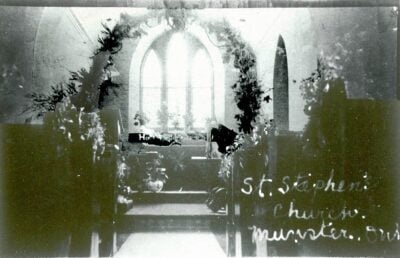
Was there ever a more focal chancel built among the Anglican churches in the Diocese of Ottawa? Perhaps only at Smiths Falls. The sole interior view of Saint Stephen’s in the Archives shows the chancel flooded with daylight from a large tripartite chancel window. Unlike many other churches where chancel windows soon filled with memorial stained glass soon after they were built, that at Saint Stephen’s remained filled with clear glass. The chancel flooded with light made the rest of the church interior seem dark by comparison, helping to rivet the attention of the congregation on what was taking place up front. The chancel was three shallow steps up from the body of the church, and the sanctuary another three shallow steps up from the chancel.
In 1888, Munster became part of the newly created Mission of Ashton with churches at Ashton, Fallowfield ((1908-1909), Munster, Prospect (from 1891), Rathwell’s Corners (or Stittsville briefly in 1890-1891), and Tennyson (from 1961). In 1967, the Mission of Ashton was amalgamated, the churches at Munster and Prospect were closed for regular Sunday services, and the church at Tennyson closed for good. The last service in Saint Stephen’s Church, Munster was held on 11 June 1967. The cemetery was sold to the Munster Union Cemetery in 1970. The former house of worship was leased to the local community and for the last half century it has served as a public library, now part of the City of Ottawa system.
The Diocesan Archives collects parish registers, vestry reports, service registers, minutes of groups and committees, financial documents, property records (including cemeteries and architectural plans), insurance policies, letters, pew bulletins, photographs and paintings, scrapbooks, parish newsletters and unusual documents.
If you would like to help the Archives preserve the records of the Diocese and its parishes, why not become a Friend of the Archives? Your $20 membership brings you three issues of the lively, informative Newsletter, and you will receive a tax receipt for further donations above that amount.
Advertisement


Saint Stephen’s Church, Munster — Deanery of the Southwest
A Kingdom of the Word
The first Munster vestry minutes date back to 1882 when the possibility of building an Anglican church in this hamlet in central Goulbourn Township was mentioned. At that time preliminary services were held in the local Orange hall. Munster, it is claimed, was named by Thomas Tubman, an immigrant from County Cavan, the first postmaster of the hamlet. Rather than have the hamlet named Tubman’s Corners, he instead urged the name of the old Irish kingdom of Munster. It was appropriate, given the large number of immigrants from southern Ireland who settled in Carleton County.
The cornerstone for this church was laid on 4 August 1886. Saint Stephen’s Church, Munster, was built in 1887 on land donated by Thomas Tubman and was consecrated by Bishop John Travers Lewis on 9 October 1887. At that time Munster was a part of the Parish of Richmond along with Christ Church, Ashton and a school in adjacent Marlborough Township.
We see here Saint Stephen’s Church as photographed by a journalist at some point in the mid 1960s before the church was deconsecrated some 60 years ago. Alas, this is the only photograph of the church exterior while still a house of worship that the Archives has been able to locate. We would be interested in learning about other photographs of both the exterior and the interior of this handsome building.
What we see here is the solid stone masonry of Saint Stephen’s. The interior also showed a striking abundance of good taste. The chancel was the centre of attention, being a separate wing of the building with its lower roof proclaiming its particular function. The chancel opened to a vestry or sacristy whose particular function was expressed by being another separate wing of the church with a different height of roof.
Was there ever a more focal chancel built among the Anglican churches in the Diocese of Ottawa? Perhaps only at Smiths Falls. The sole interior view of Saint Stephen’s in the Archives shows the chancel flooded with daylight from a large tripartite chancel window. Unlike many other churches where chancel windows soon filled with memorial stained glass soon after they were built, that at Saint Stephen’s remained filled with clear glass. The chancel flooded with light made the rest of the church interior seem dark by comparison, helping to rivet the attention of the congregation on what was taking place up front. The chancel was three shallow steps up from the body of the church, and the sanctuary another three shallow steps up from the chancel.
In 1888, Munster became part of the newly created Mission of Ashton with churches at Ashton, Fallowfield ((1908-1909), Munster, Prospect (from 1891), Rathwell’s Corners (or Stittsville briefly in 1890-1891), and Tennyson (from 1961). In 1967, the Mission of Ashton was amalgamated, the churches at Munster and Prospect were closed for regular Sunday services, and the church at Tennyson closed for good. The last service in Saint Stephen’s Church, Munster was held on 11 June 1967. The cemetery was sold to the Munster Union Cemetery in 1970. The former house of worship was leased to the local community and for the last half century it has served as a public library, now part of the City of Ottawa system.
The Diocesan Archives collects parish registers, vestry reports, service registers, minutes of groups and committees, financial documents, property records (including cemeteries and architectural plans), insurance policies, letters, pew bulletins, photographs and paintings, scrapbooks, parish newsletters and unusual documents.
If you would like to help the Archives preserve the records of the Diocese and its parishes, why not become a Friend of the Archives? Your $20 membership brings you three issues of the lively, informative Newsletter, and you will receive a tax receipt for further donations above that amount.
Dr. Glenn J Lockwood is the Diocesan Archivist.
Keep on reading
A gift of socks and something more
The Church liturgical calendar takes us into divine time
L’Avent : écouter la Parole de Dieu
All Saints’ Westboro offers resource for Advent at home
Advent: While we are waiting…
Clergy and Staff News — December 2026