
Anglicans, as individuals and as parishes, observed the National Day for Truth and Reconciliation on September 30 and throughout the week in a variety of ways.
Several Anglicans were honoured to be among volunteers selected to help carry the Memorial Cloth at the ceremony on Parliament Hill in Ottawa on Sept. 30.
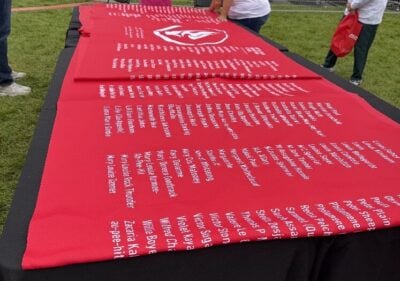
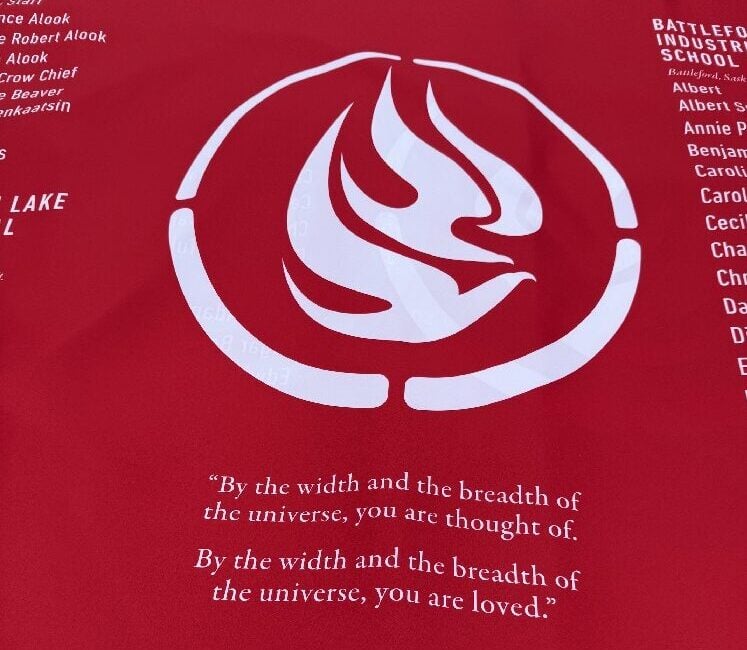
The Memorial Cloth is a 60-metre long banner of red fabric that bears the names of more than 4,000 children who were taken away from their Indigenous families and communities to attend Indian Residential Schools across Canada and who did not return home. Some died, often of diseases such as tuberculosis related to poor health conditions in the schools. Some tried to run away and were lost or died trying. This year, organizers said that the original cloth had been reprinted anew to include more names of children who had been identified as lost since the cloth was originally printed.
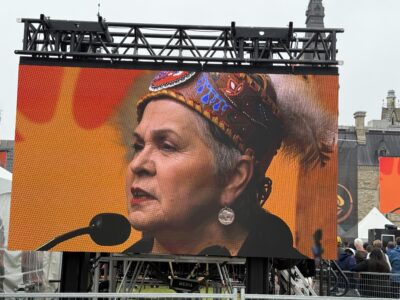
Algonquin Elder Claudette Commanda, the first Indigenous chancellor of the University of Ottawa, opened the ceremony with a prayer, thanking the Creator for the survivors of the schools and sending love to all the children who attended the schools. She prayed that September 30 would be a day of love and that all Canadians would carry that love in their hearts every day.
During the ceremony, survivors and dignitaries spoke interspersed with poetry and musical offerings from Indigenous artists. Partway into the program, volunteers gently brought the Memorial Cloth unfolded to its full length through the crowd to the stage where it was carefully folded and displayed prominently on the stage.
Janet Allingham, a member of the diocesan All My Relations Episcopal Panel and a parishioner at St. Barnabas, helped co-ordinate applications from the small group of Anglican women who volunteered to help carry the memorial cloth. “I could not help but notice the extreme care and respect with which organizers handled the Memorial Cloth during rehearsals: actions that made the children present to volunteers. Later, during practices, organizers encouraged us to walk in formation to prevent wrinkles from obscuring names,” she said. “As we walked, I thought about those names. I also remembered survivors and descendants many of whom still feel profound sorrow and loss on this and many other days…. The Memorial Cloth will lengthen over time. May this and other acts of remembrance inspire even more journeys of reconciliation in our own day and beyond.”
“The Memorial Cloth is both a visible and emotional reminder of the past, and it is part of the truth-telling,” said Jennifer Parr, a parishioner at St. Albans. “The first time I watched the memorial cloth go past me, it had more of an impact than anything I had read or heard. As you watch over 4,000 names go by you, and it wasn’t just hearing about the impact of residential schools. It’s seeing the names and imagining the people whose names are being carried on that cloth. So that, to me, to be able to carry the cloth and to carry those people in my heart as I carry the cloth, is very powerful.”
As she was waiting for the ceremony to begin, Julie Cross, a parishioner at St. Barnabas, told Perspective that she wanted to “challenge myself to remember what actually happened at the schools. I want to hold the Memorial Cloth and think about the names of the people that are right in front of me and think about what it meant to their families to lose them and not know where they were. And I want to listen and make a couple of new friends, so that I can participate better in the spirit of my country.”
During the ceremony, Governor-General Louise Arbour told the large crowd gathered that, “Honouring the truth is much more than remembering the past. It is how we begin to shape a different future. The right to truth is fundamental in any society seeking to come to terms with a painful past and to move forward on the path of reconciliation. But remembering is only one step. It must be accompanied by a commitment to ensure that injustices are never, ever repeated. We must build institutions, relationships, and attitudes that foster an environment where every person is treated with dignity, with equality, and respect. And we must also confront the forms of denialism, that persist despite extensive historical records and an undisputable body of evidence, including first-hand survivor testimony. …We need to stand together to face the future with strength.”
Marni Crossley, who is a parishioner at Christ Church Bells Corners, said that helping to carry the Memorial Cloth was a very emotional experience as she thought about the children that were lost, but she still felt privileged to be able to participate, listen and learn more about the trauma Indigenous people experiences to help her be a stronger ally.
Valerie Maier, a parishioner from Church of the Epiphany who also helped to carry the Memorial Cloth, said she was struck by “the size of the banner and how many people it took to hold it. And then moving with the banner made me think about how we need to work together. …There were corners, we had to go around, so there’s not an easy trail. We worked together, and that’s what we have to do in the future. ….Remembering the past is really important, but we’re moving forward as well together… people from all walks of life, and generations, as well working together to do this.”
Karen Luyendyk, from St. Paul’s in Almonte, shared her thoughts on a similar theme. “As I arrived on the Hill early on the morning of Sept 30, I walked by drummers practicing on the big drum…I immediately thought, “I’m home.” I pondered why I’d had this thought as a non-Indigenous person… perhaps ‘the heartbeat’? Yes, perhaps, but I also thought of the myriad ways colonialism suppressed Indigenous ceremony and practices and how all Canadians lost so very much as a result. Later in the day, Elder Claudette Commanda invited everyone to join a dancing circle as those same drummers closed the Ceremony of Remembrance, and I heard Niigaan Sinclair say, “This is how Canada was always meant to be.” So … as I joined in the dance, holding the hands of people I was meeting in that moment … I was HOME!”
Seeing so many Canadians from all generations and walks of life joining in a Round Dance together offered a hopeful coda to the solemn and sombre ceremony and reflections of the day..


Anglican parishes observe the National Day for Truth and Reconciliation
St. John the Evangelist, Ottawa
St. Thomas the Apostle, Ottawa


La prière de Jésus et la mort