
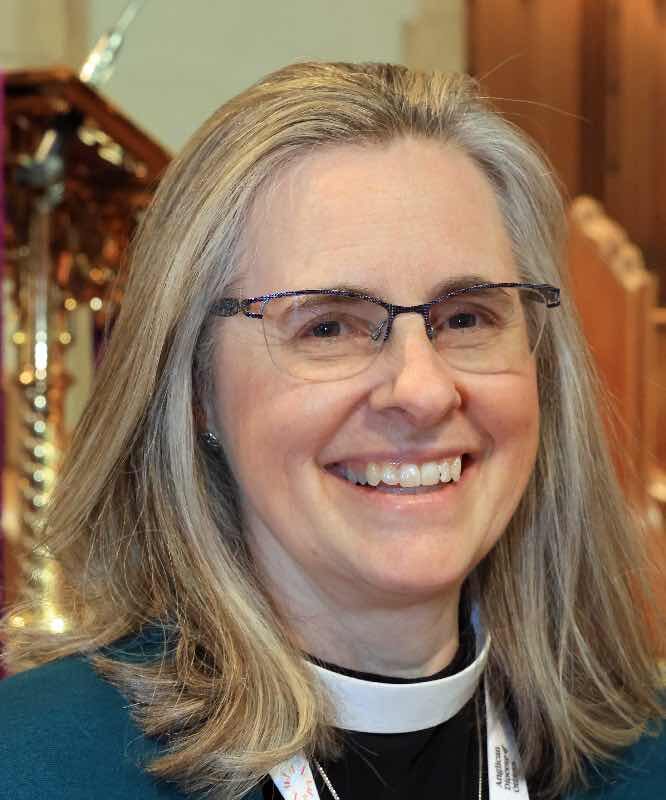
Bishop-elect Kathryn Otley graciously made time to speak with Perspective in the busy time as she was transitioning from being the incumbent at All Saints’ Westboro to preparing full-time in April to step into her new role as the 11th Bishop of Ottawa after her ordination at Christ Church Cathedral on May 9.
“It’s a liminal space,” she said, acknowledging “that’s church-speak” for a time in-between. In the time between her election on Feb. 28 and until her consecration as bishop, she has no authority in decisions concerning the Diocese but is consulted, in this case by members of senior staff and Bishop Michael Bird, who has served as diocesan administrator since Archbishop Shane Parker concluded his time as bishop in September after his election as primate of the Anglican Church of Canada. This was also a time of transition for her as she said farewell to parishioners at All Saints’.
The Episcopal election
During the episcopal election process, she said she had felt at peace. Nominated once before in 2020, she recounted feeling nervous at that time, during the public meetings in the lead-up to the election and her relief that Archbishop Parker was the one who would lead the Diocese through the pandemic years. She added that she thought he would be bishop until she retired and had only hoped she might mentor and encourage another woman to let her name stand in a future election.
After being nominated for this election and taking the time to discern whether to let her name stand, she said that during this election process, she was much more comfortable simply sharing her thoughts and her gifts and then leaving the decision up to the Synod members. “On the day of the election … I was at peace because I knew that I’d done a good job saying who I am. And the rest of it was out of my hands,” she said. “It was a wonderful shock and a real blessing and an honor to be elected.”
Preparations for her consecration and installation
New bishops require the robes and symbols to go with the office. Otley is inheriting or being gifted with much of what she needs from within the church family. “I will be using the mitre and cope that Bishop John Chapman had made for the Diocese. It has the diocesan crest on the back, which is really lovely,” she said. The Cathedral parish is giving her a cassock. “My family is giving me the ring. And [the All Saints’] parish is giving me the pectoral cross.
Her crozier will have a special meaning. “Archbishop Shane reached out to me, and said, ‘Michael Peers’ crozier is here at the national office…[a gift from the Peers family for another bishop to use.]” He sent a photo of it, and it was just like one she had been thinking of purchasing. “Archbishop Shane loves doing wood projects, so he cut it to my size, put a new base on it, finished it all, and it’s waiting for me at the Cathedral. So, for me, it’s special both because my former bishop crafted it anew for me and because I met Michael Peers a number of times. I know him. He’s the first person who did the apology [to Indigenous people on behalf of the Anglican Church]. So, for me to have his crozier is beautiful. I’m that kind of person. I like history and there’s a connection there and so I’m thrilled,” she said.
Deep Anglican roots
The bishop-elect shared a story about another special connection with Archbishop Fred [Hiltz] who will lead her pre-consecration retreat.
After she had been ordained as a priest here in Ottawa, she attended a New Year’s Day service and levee at Christ Church Cathedral when Archbishop Hiltz was there to make his annual address as primate. Afterwards, she joined the long reception line to greet him: “I had my clergy collar on, and I shook his hand, and he looked at my name tag. He looked at my face and he looked kind of puzzled…. I said, ‘My father, Roger Otley, helped with a diocesan stewardship campaign in Nova Scotia.’ He said, ‘It’s not your father.’ Then he asked, ‘What is your mother’s maiden name?’ And I said, ‘Reeves.’ And he turned to his wife and said, ‘Lynn, it’s Connie’s granddaughter. And she’s a priest!’ I was wondering ‘How do you know my nana’s name?’ … It turned out that their first placement after he’d been ordained was in Mulgrave, Nova Scotia where my grandparents were faithful members. My grandmother had made them very welcome. The astonishing thing is he looked at my face and saw my grandmother.
The next year, … he teared up when he gave me communion. The following year I said to my family, ‘Mom, you and I and Heather, (that’s my daughter. We all look alike) we’re going to make the primate cry! So, the three of us went up to receive communion. As we put our hands out to receive the bread, my mother began to cry. We’ve never forgotten that. I’m so thrilled that Archbishop Fred will lead my retreat in Toronto.”


Will there be new strategic plans and priorities?
Otley said that the first thing she plans to do is meet with senior staff and listen. Having been an ordained priest in the diocese for 20 years and an engaged parishioner before that, she added that she does not a “come-from-away, to use a Maritime expression.” Over the decades, she has seen plans made and then shelved, but the Embracing God’s Future strategic plan, created during Bishop John Chapman’s time, is different. She took part in evaluating how work on it was progressing. She witnessed how priorities were decided and change was implemented for both parish ministry and community ministries during Archbishop Shane’s time, as he built on such a solid foundation.
“I’ve come in at a time where we’re doing an evaluation of the last three years, and we’re looking forward. Where do we go from here? I’m really comfortable with that. I don’t believe that I need to come in with all new ideas—that would be arrogant and not helpful. … I would like to both evaluate and be clear-headed about where it is going strong and where it’s faltering, and decide together: Do we add more resources to shore that up? Or do we say, you know what? That’s not working.”
Parishes and the broader church continue to face the challenges of declining church attendance and financial support. What do you recommend?
“As Anglicans, we have all the best intentions in the world, and we try to imagine what would bring people to join us, but I think we’re still trying to create relationships of exchange. We want to build relationships, but we want to change something [the music or liturgy] so that you’ll come so that we get something from you. And in our demographic case, it’s often that people are tired of doing all the work. What is it? 20 percent of the people do 80 percent of the work, and they’re exhausted. And they want young people to come in so they can hand it all over to them intact. ‘This is the way we’ve always done it. I do for you, so you do for me.’ It’s transactional. That’s actually not God’s economy. It isn’t. …
“I think a couple things have to change…. We need to get out of transactional relationships and into relationships that really want to know you. What is your experience of God? Or what are your questions? If you say, ‘I don’t have an experience of God. I’m in despair. I’m looking for something.’ Well then, we need to care about you and what you’re looking for. Over and over again, I have said, we need to listen. Unless we listen, we are never going to be able to actually respond to the need.
How can the diocesan church best support the Anglican Community Ministries?
Listening with a heart that’s open is key in other contexts as well, she pointed out. “I want to listen to Victoria Scott [director general of Anglican Community Ministries] and the executive directors… I also want to create a team that talks about what causes people to be homeless and on the street. We need to raise up our awareness … because otherwise we’re responding from what we think is needed rather than what people actually need.”
Otley recounted organizing an event about homelessness and housing with Canon Hilary Murray. “I had this wonderful homelessness liturgy all prepped, and we had a plan to do all this stuff. Moira Davis (Alie) had invited a young person to come in who was living on the streets. …And we were blown away by what they shared: ‘I have no trouble getting food in Ottawa. There are so many places. I don’t need sandwiches. What I need is phone card credits. Because when I’m on my own, I need to be able to connect with people, so that if I’m afraid, if I need help, I can call someone right away,” they said. “What drew me out and pulled me off the street was because I found a squirrel that was hurt, and I nursed it back to health. And partway into that, I realized I was treating the squirrel better than I was treating myself. It was caring for another that helped me realize I wasn’t caring for myself.’
All our plans were made ‘imagining’ what was needed on the street. An encounter with a person with lived experience changed my approach forever. “I’ll never forget that,” said Otley, clearly moved.
Taking action together
Otley added that it’s also vital to go beyond listening. “Sometimes I have found in our church, and sometimes this happens with reconciliation, we’re trying so hard to become aware and to listen that we never move beyond that…. You’re never going to learn it all, so you need to listen, you need to become informed and aware, and then you need to work together and take action.”
Working in partnerships
She observed that different Christian denominations and interfaith partners are all “working for the same purpose—helping people that are in need. And then you have your civic partners, your non-religious partners, who are also helping. It is ridiculous … to do this in silos. We are so much stronger when we work together…. And I’m all for making partnerships. And I think it’s a superpower.”
She says one of her own gifts that lends itself to partnerships is that she gets along with people. Her practice of non-anxious leadership may avoid getting people’s backs up, she said, but the practice of listening is essential. “And not being ashamed of who I am as an Anglican and a leader in the Anglican church…. I share our perspective. I listen to theirs. We enrich each other and then we move forward.” She added that inviting others to collaborate also helps raise awareness in the broader community of the work Anglicans do in Community Ministries and in parishes.
The Rev. Dr. Christopher Brittain says that many of the new students entering Trinity College’s Divinity program are not cradle Anglicans. They are new Christians and new to Anglicanism. What do you think is drawing them to the Anglican Church?
“I think part of it is that we as a church are settling into ‘this is who we are.’ We’re Anglicans. We still have our traditions, but we incorporate more inclusive language, some more inclusive rites, music from different cultures, so we’re broadening our identity… We can be enriched by others’ experience of God. And I think, especially in a university setting, that is what draws students. Because Anglicans have the ability to offer the ritual and sacraments and our beautiful, beautiful tradition, but we also have the openness to say we don’t have it all—it’s okay to doubt. We don’t have all the answers.”
Do you have a plan in mind for youth ministry?
Otley said she has some ideas, but first, she wants to listen to the youth, get to know them and build relationships that are about “caring about who you are and what your questions about faith are. It’s about nurturing faith. We have so many opportunities for people to have meaning in their lives and purpose and, when the world is full of anxiety and despair, to have hope. To me, faith is not a feeling. Faith is trusting in that hope and moving forward in that context…
“I’m wondering, I’ll put it in a Godly play turn of phrase, if instead of a central focus, we could have a deanery focus. For two reasons: it means better proximity, so you don’t have to travel as far. And we bring the resources to those deanery centers… I’m hoping in a deanery region that there will be enough [youth] for a critical mass, and they will be close enough in geography that they actually have similar issues.” She added that there are many clergy in the diocese with gifts for building relationships with youth, and she wants to encourage parishes to share their ideas and successes.
Do you have a summer holiday plan? What do you like to do for fun?
“I almost always go to the Maritimes to my family.…I camp, I kayak and I hike, always with my trusty companion, Madrigan, my dog, (Madi for short. It means little dog in Irish Gaelic.) She’s half terrier, half miniature poodle and fits in my kayak. She’s a good traveller. I also have a cat, Maebh, but the cat stays home.
“In the winter, I do different outdoor things (snowshoeing, cross country skiing). And I love to do handwork — needlework of all different kinds, cross stitch, knitting, crochet, canvas work. I find that relaxing and almost meditative. I love creative things, so I’ve done Bible art journalling, which is a mixed media art. Also, I am a voracious reader. I love to read and I’m eclectic — science fiction, fantasy, non -fiction, biography, history. I just love it and I love finding out how things work so sometimes I just want to learn about how when you put a needle on a record, sounds come out. I’ve got that kind of mind that likes to understand things. And I love solving puzzles of all sorts”
You have mentioned your non-anxious style of leadership. Any advice for anxious Anglicans in these troubled times?
“In a time that is full of anxiety, I want to write things, to preach things, to communicate in a way that acknowledges your anxiety. I’m not trying to push it under a carpet or shame you. No, I want to acknowledge that anxiety is real. And then I want to bring to bear the prayer and the activity of the Holy Spirit in our lives. That gives us hope.”
She described a favourite cartoon: “There are two people. One is bent over on the ground, and one is standing up behind. The one that’s standing up is saying, ‘I don’t know what’s coming in this year. There are wars. Prices are going up. I don’t know what I’m going to do. What are you going to do? What are you thinking is going to happen this year?’
And the person on the ground looks up and says, ‘I think what’s coming next year is flowers.’
‘What? What do you mean flowers? Are you denying that there’s war? How can you say there’s going to be flowers?’ the first one asks.
And the one on the ground says, ‘Because I’m planting flowers.’
“I think that’s how I look at it. …. You need to acknowledge the existence of the anxiety and the things that cause it, and then you need to offer hope. We need to plant those seeds together. I’m not going to be the answer. I’m not going to be only the seed planter. I need to invite people to come alongside and see that there’s hope.”
All are welcome to attend the Ordination and Consecration of
The Venerable Kathryn Anne Otley
as a Bishop in the Church of God and her Seating as the 11th Bishop of Ottawa on
May 9, 2026, at 10:30 am at
Christ Church Cathedral Ottawa (414 Sparks Street).
The service will also be livestreamed on the Cathedral’s YouTube Channel: https://www.youtube.com/@ChristChurchCathedralOttawa
Saint John’s interior circa 1890s — Ottawa Centre Deanery